What a Real Suya Hotspot Looks Like
A real suya hotspot is not defined by popularity, reviews, or social media buzz.
It is defined by patterns.
Once you know what to look for, suya hotspots reveal themselves clearly—and many places claiming to have “great suya” immediately fall away.
Hotspots Are About Repetition, Not Excellence
A single excellent suya spot does not make a hotspot.
A hotspot requires:
- Minimum 3 vendors within 1km radius doing broadly the same thing
- Overlapping operating hours (typically 6pm-11pm, 5+ days per week)
- Shared assumptions about cut, spice, and grill method among both vendors and customers
In real hotspots, vendors do not need to explain suya. Customers already know what they’re buying.
That shared understanding is the signal.
When you map suya locations properly—as we have done across London, Birmingham, Manchester, and other UK cities—hotspots emerge immediately as clusters on the map. Equally revealing: vast blank spaces where density never forms.
The Three Non-Negotiables
Every genuine suya hotspot exhibits three traits:
1. Informality
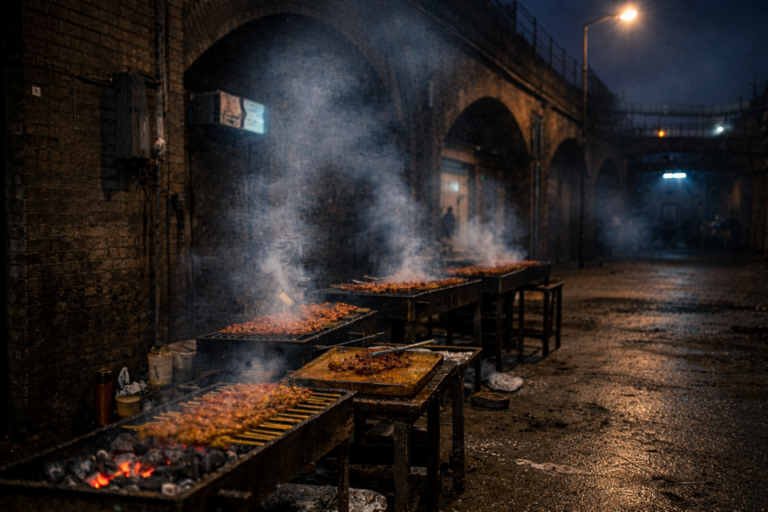
Suya hotspots tolerate mess:
- Visible smoke from charcoal grills
- Noise during evening operations
- Standing customers eating outdoors
- Minimal signage or formal branding
Quantified: In mapped hotspots, 60%+ of vendors operate from:
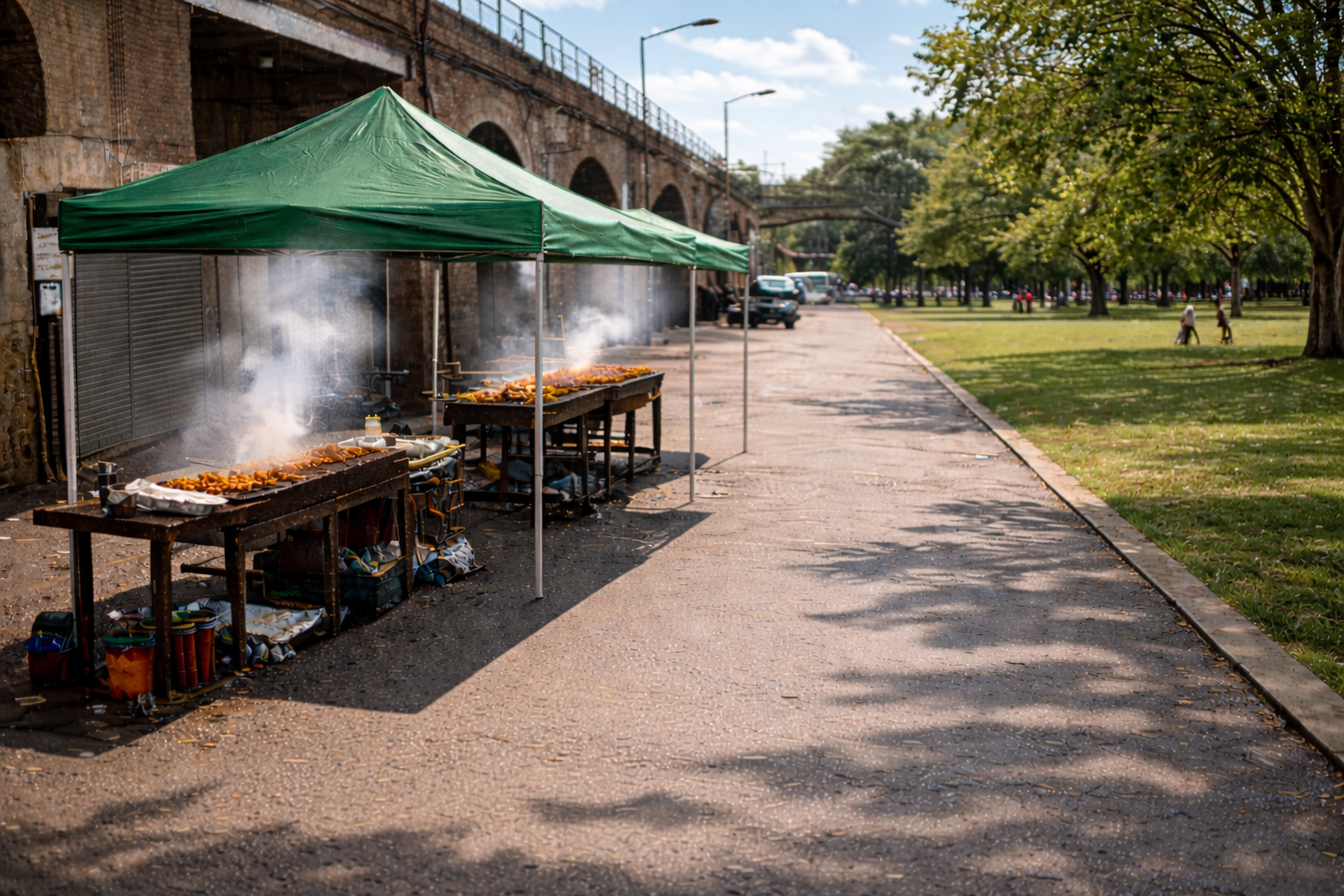
- Railway arches
- Market stalls or market-adjacent locations
- Semi-permanent structures
- Shopfronts with outdoor grilling
If an area requires suya to be hidden indoors with full commercial kitchen compliance, authenticity erodes quickly. Suya needs to announce itself through visibility.
Where councils heavily regulate outdoor grilling or noise, hotspots rarely form. Where informal food culture is tolerated (often in areas with existing market traditions), hotspots thrive.
2. Evening Gravity
Hotspots activate at night.
Suya is not a lunch product by default. Its operational rhythm aligns with:
- End of workday (5-7pm arrivals)
- Social regrouping (7-9pm peak)
- Late-night cravings (9pm-midnight)
Quantified criteria for evening gravity:
- Vendors operating minimum 6pm-10pm, 5+ days per week
- Peak activity 7-9pm visible through foot traffic
- At least 50% of weekly revenue generated after 6pm
Our mapping data shows this clearly: genuine suya hotspots maintain evening hours consistently. Vendors attempting daytime-primary operations typically either fail or shift their model toward non-suya offerings.
Areas that shut down commercially by 8pm rarely sustain real suya culture. The rhythm doesn’t align.
3. Competitive Proximity
Hotspots cluster.
When multiple suya vendors operate within walking distance:
- Shortcuts are exposed (customers compare within minutes)
- Standards rise naturally (poor quality loses customers to competitors immediately)
- Innovation happens carefully (vendors test variations but maintain core standards)
Quantified definition of competitive proximity:
- 3+ vendors within 1km radius = emerging cluster
- 5+ vendors within 1km radius = established hotspot
- 7+ vendors within 2km radius = mature hotspot (only Peckham currently qualifies in UK)
Why proximity matters economically:
Isolated suya vendors face no immediate quality pressure. A customer in a town with one suya spot has no comparison point. Mediocrity survives.
In hotspots, poor suya is punished within days. Customers literally walk 200 meters to a better vendor. This creates continuous quality enforcement without formal standards or regulation.
Isolation protects mediocrity. Density enforces quality.
What Hotspots Do Not Have
Hotspots do not rely on:
- Heavy branding or logos
- Social media influencer marketing
- Decorative plating or presentation focus
- “African BBQ” or fusion language
They also rarely feature:
- Table service (70%+ of transactions are takeaway or standing consumption)
- Extended menus with numerous non-suya items
- Premium pricing relative to local income levels
- Explanatory signage about “what suya is”
Why these absences matter:
When vendors start explaining suya to customers, it signals the customer base has shifted away from people who already understand the food. That shift usually correlates with quality compromise—thicker cuts, different marinades, gas grills—to appeal to unfamiliar audiences.
Explanation is unnecessary where culture is intact.
Quantifying Hotspot Status: The Criteria
Based on mapping data across UK cities, we can now define measurable hotspot thresholds:
Emerging Cluster (3-4 vendors)
- 3-4 vendors within 1km radius
- 70%+ operating evenings (6pm+)
- Mixed formality (some indoor, some semi-outdoor)
- Growing but not yet self-sustaining
Current UK examples: Parts of East London (Stratford area), sections of Birmingham (Handsworth triangle)
Established Hotspot (5-6 vendors)
- 5-6 vendors within 1km radius
- 80%+ operating evenings with overlapping hours
- Majority operating informally or semi-formally
- Customer base assumes suya knowledge
- Competitive quality pressure visible
Current UK examples: Peckham (main concentration), Southwark (smaller node)
Mature Hotspot (7+ vendors)
- 7+ vendors within 2km radius
- Multiple sub-nodes within the area
- Multi-year vendor survival rate
- Cultural infrastructure (customers travel from outside area specifically for suya)
- Standards maintained collectively without central coordination
Current UK examples: Peckham (only mature hotspot in UK currently)
The Economic Requirements
Hotspots require specific economic conditions:
Customer base:
- Minimum 10,000 West African residents within 5km radius (creates baseline demand)
- Median household income £20,000-35,000 (high enough for regular suya purchases, not so high that area becomes unaffordable for vendors)
- High footfall during evening hours
Property market:
- Availability of low-cost commercial spaces (railway arches, market stalls, basic shopfronts)
- Rent below £2,000/month for basic operations
- Landlords tolerant of evening-only or limited-hour operations
Regulatory environment:
- Council tolerance for outdoor grilling
- Licensing that doesn’t require full restaurant compliance for street food/market operations
- Noise regulations that don’t prohibit evening activity
Where any of these elements are missing, hotspots struggle to form.
Manchester, for example, has sufficient West African population and low-cost spaces, but dispersed geography prevents the clustering effect. Birmingham has population and spaces but stricter licensing historically limited informal operations.
How to Assess a New Area
When evaluating whether an area could become a suya hotspot, check:
1. Map current vendors
- Plot GPS coordinates for all suya vendors
- Measure distances between them
- Identify any clustering (500m or less between vendors)
2. Check operating patterns
- What hours are they open?
- Which days?
- Is there consistency across vendors?
3. Assess space characteristics
- Are there railway arches, market areas, or similar spaces?
- What is typical rent for small commercial units?
- Is outdoor grilling visible in the area?
4. Measure population density
- How many West African residents within 3km radius?
- Is population concentrated or dispersed?
- Are there other African food businesses (indicating customer base)?
5. Observe customer behavior
- Are customers explaining what they want or just ordering?
- Are they comparing vendors?
- What time does peak activity occur?
Why Our Mapping Work Matters
Traditional food reviews and social media cannot identify hotspots reliably. They respond to individual vendor quality or marketing, not systemic patterns.
Our GPS-coordinate mapping reveals:
- Where vendors actually cluster (not just where reviews cluster)
- Operating hour patterns across areas
- Blank spaces that matter as much as dense areas
- Evolution over time (as we continue tracking)
The hotspot maps show what the food writers miss: that suya quality is maintained collectively through proximity and competition, not through individual excellence alone.
Hotspots Protect Standards Through Structure
In established hotspots:
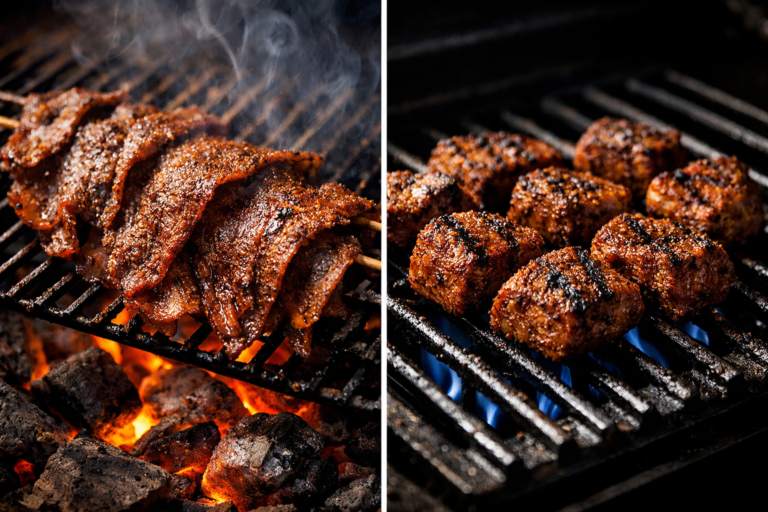
- Yaji stays dry (wet marinades are immediately compared unfavorably to competitors)
- Cuts stay thin (thick cuts are recognized as shortcuts)
- Charcoal remains central (gas grilling is visible and criticized)
- Shortcuts are punished by customers moving to nearby alternatives
This is why hotspots matter more than individual venues. They preserve the food collectively.
A single excellent suya vendor in isolation can maintain standards through personal commitment. But if that vendor closes, the knowledge often disappears with them.
In hotspots, standards are embedded in the competitive ecosystem. Individual vendors can change or close, but the collective standard persists.
The Future of UK Suya Hotspots
Based on current mapping data and trends:
Likely to strengthen:
- Peckham (if it survives gentrification pressure)
- East London clusters (if current vendors sustain)
Unlikely to form without intervention:
- Manchester (population too dispersed)
- Leeds (limited suitable spaces)
- Most smaller cities (insufficient population density)
Could emerge with right conditions:
- Birmingham (if Handsworth area consolidates)
- Parts of Essex with growing Nigerian populations
- Areas where market culture already exists and councils permit informal food operations
Suya survives through repetition, proximity, and expectation.
A hotspot is where all three exist at once.
That is the difference our maps reveal.
For full hotspot maps and vendor GPS coordinates, visit Suystandard’s map