Why Real Suya Needs Thin Cuts and Charcoal
Why Thin Cuts Matter and Why Charcoal Is Non-Negotiable
Suya gets argued about in the wrong order.
People obsess over whether the beef is grass-fed. They debate gas versus charcoal like it’s just personal preference. They post close-ups of glistening skewers and call it “premium.”
None of that gets to the heart of it.
If you want to understand why some suya actually sings and most of it just sits there, you only need to grasp two things:
Thickness beats provenance.
Fuel determines identity.
Everything else is downstream.
Thin Cuts: The Physics of Surface Area
Here’s the uncomfortable truth: good suya can be made from average beef. Bad suya gets made from expensive beef all the time—because it’s cut wrong.
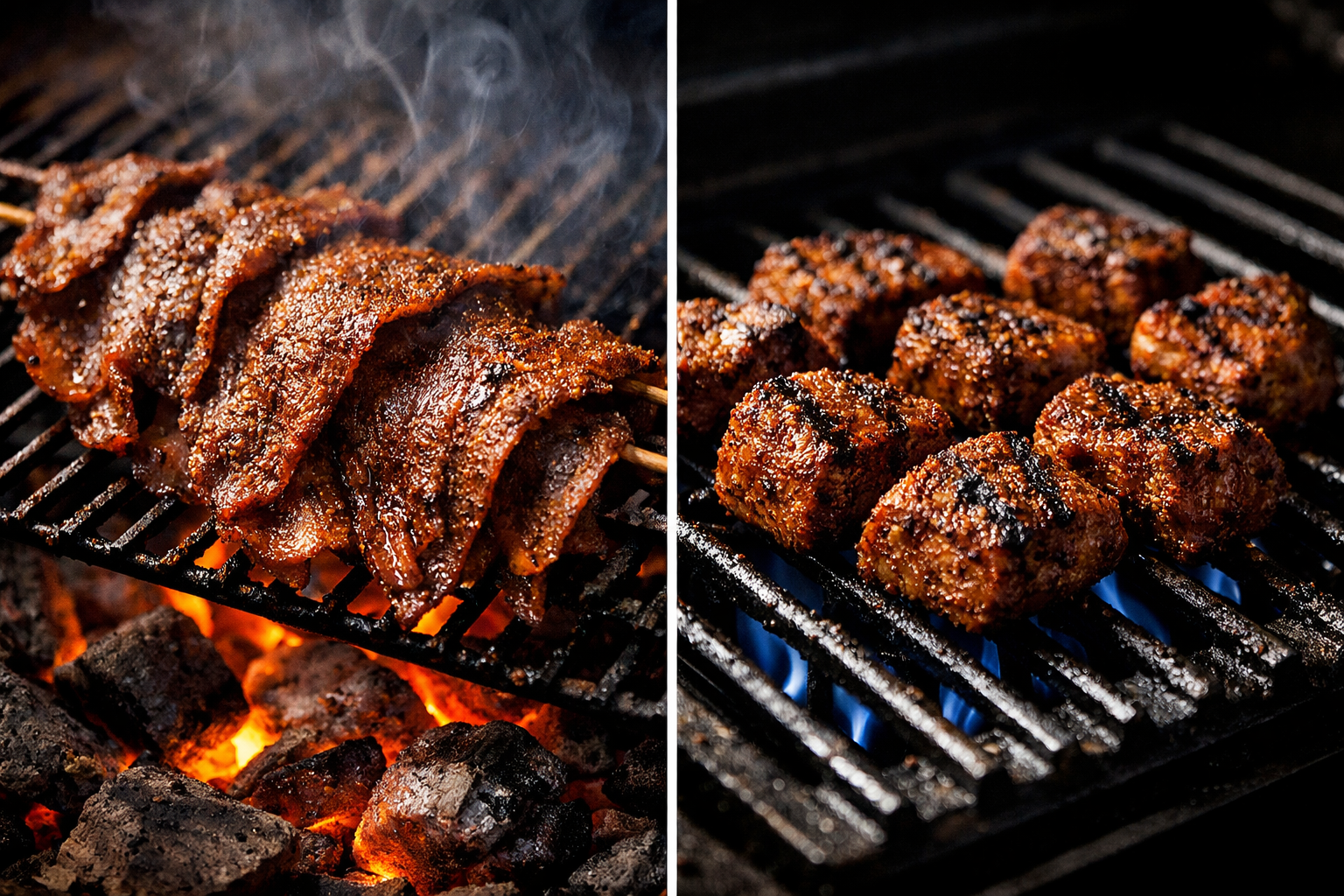
Suya lives at the intersection of heat, smoke, and spice. The thinner the meat, the more completely those three forces can do their work. We’re talking 3–5mm thick—thin enough that it drapes over the skewer rather than sitting rigid like a kebab chunk.
When meat is cut this way, three things happen fast on the grill:
Fat renders immediately, carrying spice oils to the surface.
Yaji blooms properly, toasting instead of steaming.
Smoke penetrates deeply, because there’s more exposed surface for it to cling to.
The result is what real suya actually is: crisp at the edges, smoky, aromatic, tender—not soft, wet, or rubbery.
Thick cuts break this system completely.
Once you go past about 7mm, the outside chars before the inside cooks. Vendors compensate by lowering the heat, which kills the smoke. Less smoke means flatter flavor. To compensate again, they add wet marinades or cook longer—and suddenly you’re not eating suya anymore. Just spiced grilled beef.
This is why so much UK suya tastes “safe.” Thickness is the original sin.
So why do vendors still get it wrong?
Yield anxiety. Thin slicing creates trimmings. Chunky cuts “look like more food” even though they taste worse.
Knife skills. Consistent, paper-thin slicing is hard work.
Instagram. Thick meat photographs better. Real suya doesn’t.
Gas grills. Thin cuts dry out fast on gas, so vendors are forced to go thicker—which triggers a whole chain of compromises.
Here’s what thin cuts actually do beyond taste: they force honesty. You can’t hide poor technique, weak spice, or bad heat behind them. Either you know what you’re doing—or you’re exposed.
Charcoal vs Gas: Not Even Close
People talk about gas-grilled suya like it’s “almost the same.”
It’s not. It’s categorically different food.
Charcoal does three things gas physically cannot replicate:
1. Smoke is seasoning
Charcoal combustion produces phenolic compounds—guaiacol, syringol—that bind to fat and penetrate the meat. That smoky note isn’t decoration. It’s part of the recipe. Gas produces heat. That’s it.
2. Uneven heat creates complexity
Charcoal burns irregularly. A good charcoal grill hits 700–850°F in the hotspots, with cooler zones around 500°F. Those temperature variations create layers: char, sweetness, bitterness. Gas distributes heat evenly—which sounds ideal until you realize it produces monotone results.
3. Fat ignition is where magic happens
When rendered fat drips onto hot coals, it flares briefly and caramelizes the spice instantly. That moment is where much of suya’s character is born. Gas grills either prevent flare-ups entirely or use lava rocks that add hassle without adding flavor.
The taste difference is structural, not subtle.
Gas-grilled suya tends to be cleaner, blunter, more “meaty.”
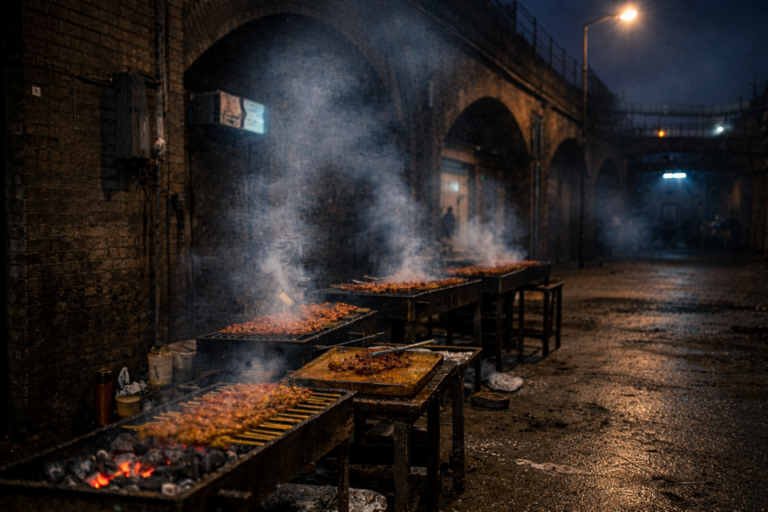
Charcoal-grilled suya announces itself—you smell it from 20 meters away. Layered, bitter-sweet, spicy, lingering.
If you can’t smell suya before you see it, something’s already wrong.
The UK Reality: Why This Is So Hard
Now here’s where it gets complicated.
Everything I’ve just described—thin cuts, charcoal heat, smoke in the air—runs headlong into UK commercial reality.
Most suya vendors here face impossible choices:
Regulatory barriers: Food hygiene ratings often require enclosed kitchens. Planning restrictions ban outdoor grilling in many boroughs. Residential complaints shut down smoke operations.
Insurance costs: Charcoal grilling either makes insurance prohibitively expensive or simply unavailable. Gas is “safe.” Charcoal is “liability.”
Actual costs: Charcoal runs £8–12 per 10kg bag. A busy evening uses 2–3 bags—that’s £20–30 in fuel alone. Gas costs maybe £5 for the same output. Over a month, you’re looking at £400–600 for charcoal versus £100–150 for gas.
For vendors operating on the margins shown in our Peckham economics article, that’s not trivial.
So vendors face a forced choice:
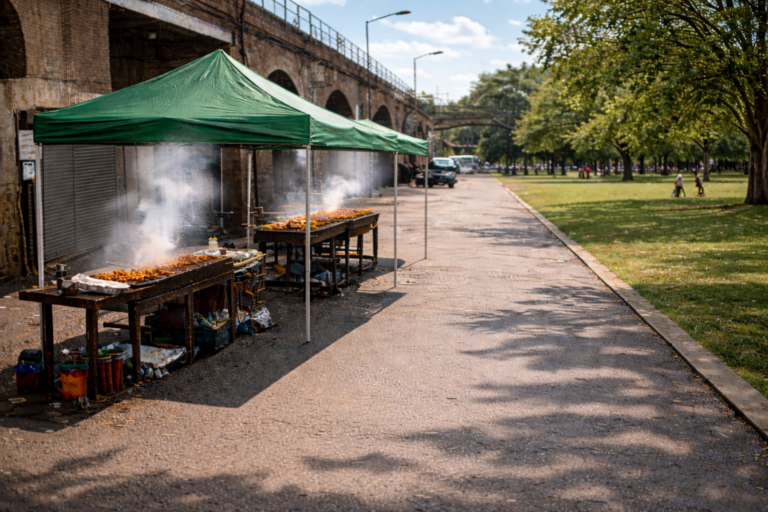
- Operate informally with charcoal (Peckham railway arch model—tolerated, not legal)
- Formalize and compromise with gas (lose authenticity, stay compliant)
- Don’t operate at all
This isn’t about lazy vendors taking shortcuts. It’s about a regulatory environment that makes authentic suya extraordinarily difficult—sometimes impossible—to produce legally.
That’s a systemic problem requiring advocacy and reform, not just better vendor choices.
But here’s the thing: acknowledging why vendors use gas doesn’t change what happens to the food. Gas-grilled suya is still fundamentally different. The question isn’t whether vendors have good reasons—they often do. The question is whether we’re honest about what gets lost.
Where the Two Truths Meet
Thin cuts and charcoal aren’t separate debates. They reinforce each other.
Thin cuts need charcoal to reach their potential—the rapid fat rendering, the flare-ups, the deep smoke penetration.
Charcoal demands thin cuts—anything too thick burns outside before cooking through.
Together they form a system. Break one part and the other collapses.
This is why real suya still looks the way it does:
Dry yaji
Paper-thin slices
Charcoal smoke in the air
Grillmen adjusting by instinct, not timers
It’s not nostalgia. It’s coherence.
Suya has adapted across continents and generations—in spice blends, serving styles, even cuts of meat. But the core process can’t bend: thin cuts, dry spice, charcoal heat. Compromise those and the chain breaks.
You can innovate around presentation. You can modernize branding. You can experiment with sides.
You cannot innovate around fuel and thickness.
Thinness is the discipline.
Charcoal is the soul.
Everything else is noise.
The Suya Standard documents the authentic process—not to condemn vendors operating under impossible constraints, but to preserve the knowledge of what should be possible.
Because until we’re honest about what real suya requires, we can’t fight for the conditions that make it viable.