Why Peckham Became London’s Suya Capital
Peckham did not become London’s suya capital by accident.
It happened through a specific combination of migration patterns, urban space, informal economies, and cultural continuity. Strip away the hype, and a clear pattern emerges: suya thrives where formality is low and community density is high.
Peckham meets those conditions better than anywhere else in the UK.
How the Density Formed
Peckham’s suya concentration has roots in migration economics.
During the 1990s and 2000s, South London—particularly Peckham, Camberwell, and Brixton—became primary settlement areas for Nigerian immigrants. The reasons were straightforward:
- Affordable housing relative to North and West London
- Existing African and Caribbean communities that reduced isolation
- Transport links via the Overground and buses connecting to central London work
- Informal commercial tolerance inherited from decades of Caribbean market culture
By the early 2000s, Peckham had one of the highest concentrations of West African residents in the UK. That density created something crucial: permission.
Permission to grill outside.
Permission to operate late.
Permission to sell food that is eaten standing, not plated.
Permission to prioritise flavour over presentation.
Where communities are sparse, suya is forced indoors and formalised. In Peckham, it remained exposed.
Space Matters More Than Rent
Many Peckham suya operations occupy:
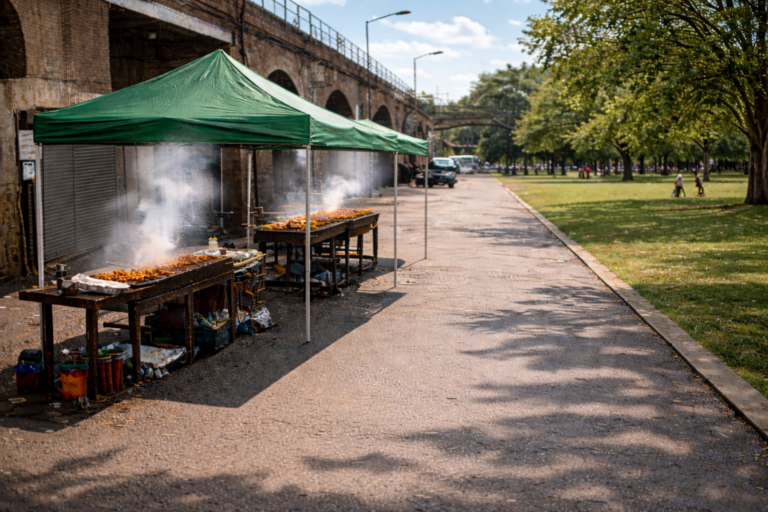
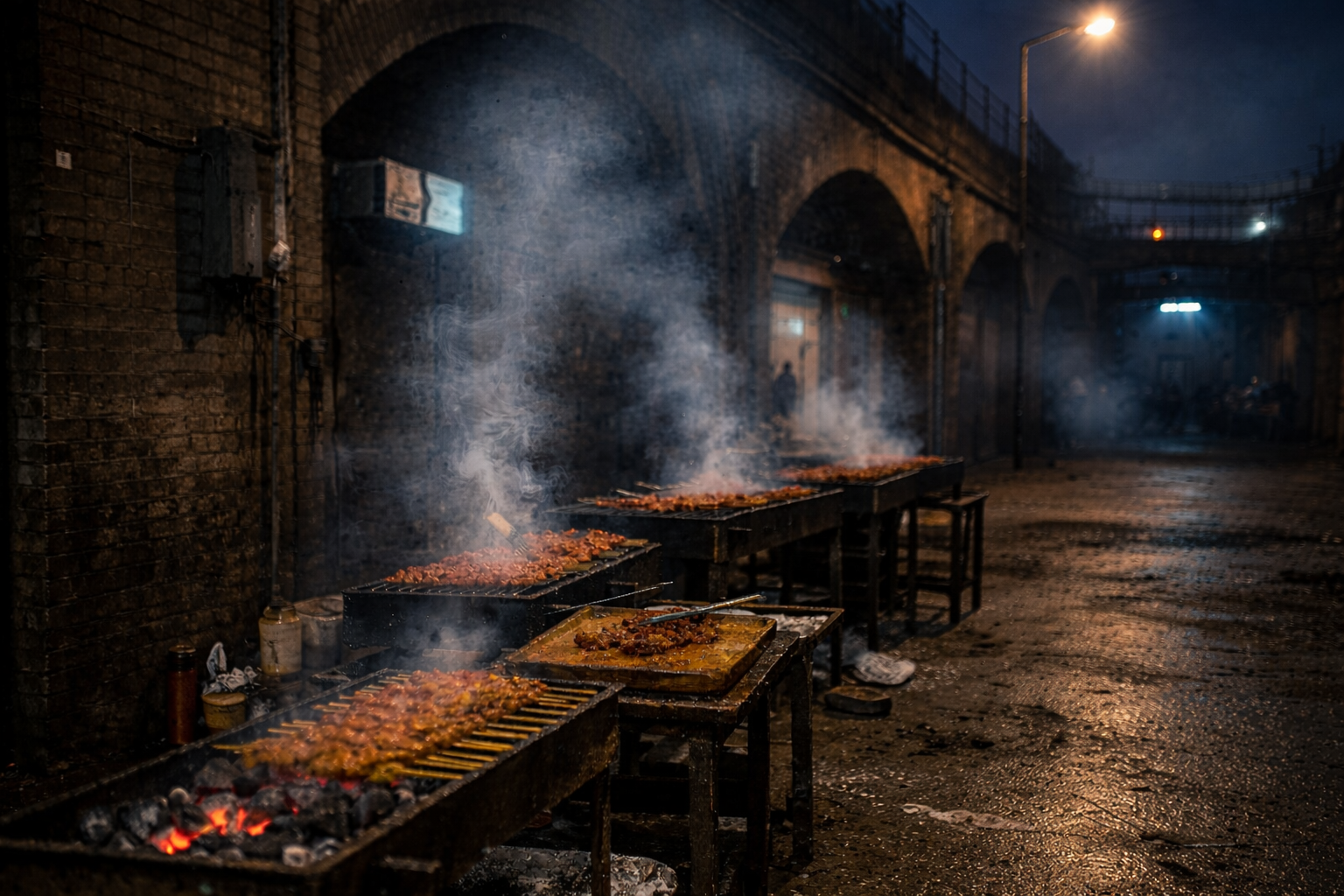
- Railway arches along the Overground line
- Side streets off Rye Lane
- Market-adjacent locations
- Temporary or semi-permanent structures
These locations are not accidental. They represent specific economic conditions.
Railway arches, in particular, create ideal suya environments:
- Monthly rents £800-£1,500 vs £3,000-£5,000 for equivalent high street units
- Natural ventilation—heat and smoke escape without extraction systems
- Activity and noise are expected, not policed by residential complaints
- Flexible lease terms that accommodate seasonal or evening-only operations
Compare this to a standard restaurant lease:
- Commercial kitchen requirements (extraction, gas safety certificates)
- Fixed operating hours enforced by license conditions
- Higher rent demands consistent daytime trading
- Planning regulations that restrict outdoor grilling
Suya’s operational logic—charcoal, smoke, evening peaks—conflicts with standard restaurant economics. Railway arches resolve that conflict.
This is not incidental. Architecture shapes food.
Why Restaurants Followed, Not Led
Contrary to popular belief, Peckham’s restaurants did not create the suya scene. They followed it.
The timeline matters:
Late 1990s-early 2000s: Informal suya appears at Rye Lane Market and evening spots along Peckham High Street. Grills operated by individuals, often part-time, serving predominantly Nigerian customers.
Mid-2000s: Semi-permanent suya operations establish near Queens Road Peckham station. Names like 805 Restaurant (opened ~2006) and Enish begin adding suya to existing Nigerian restaurant menus—but as an addition to their core offerings, not the lead product.
2010s: Dedicated suya spots emerge. Ola’s Afro Caribbean and Asun Jollof both operate from railway arches with suya as primary offering. Operating hours shift later (7pm-midnight common).
Post-2015: Gentrification wave brings new audiences. Some venues formalize—printed menus, Instagram presence, broader marketing. Others maintain original format.
This sequence is critical.
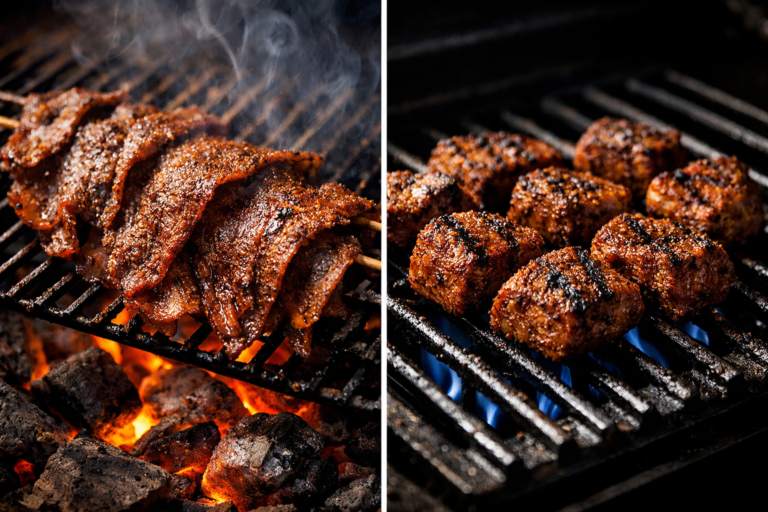
Where suya is born inside restaurants, it is usually compromised:
- Thicker cuts (easier for inexperienced grill staff)
- Wet marinades (longer shelf life, less frequent preparation)
- Gas grills (insurance and safety compliance)
- Plated presentation (higher margin, table service)
Peckham’s suya emerged outside first. That preserved its form.
The Peckham Pattern
Our mapping data reveals the clustering clearly:
Within a 2km radius of Rye Lane:
- 7+ dedicated suya vendors
- 12+ venues serving suya alongside other offerings
- Operating hours predominantly 6pm-11pm
- Concentration around three nodes: Rye Lane Market area, Queens Road station vicinity, Peckham Rye station surroundings
This clustering creates feedback:
- Vendors compete quietly on quality
- Customers develop discernment (comparing vendors within walking distance)
- Poor suya is quickly exposed and either improves or closes
- New vendors must meet established standards to survive
Peckham didn’t just accumulate suya spots. It refined them.
Compare this to isolated suya vendors in areas like Reading or Cardiff. Single vendor operates without local comparison. Standards drift. Customers have no reference point. Compromises accumulate.
The Economic Reality
Peckham’s suya economy operates on different margins than standard restaurants:
Typical suya operation costs (railway arch location):
- Rent: £1,200/month
- Charcoal: £300-400/month
- Staff: 1-2 people (often family/community)
- Raw materials: ~35% of revenue
- Operating hours: 30-35 hours/week (evening focus)
Break-even: £3,000-4,000 monthly revenue
Sustainable: £6,000-8,000 monthly revenue
These economics require:
- High footfall during limited hours
- Customer base that understands suya (no education/convincing required)
- Repeat business from local residents
- Word-of-mouth rather than marketing spend
Only dense West African communities generate these conditions reliably.
Why This Hasn’t Been Replicated Everywhere
Many UK areas have West African populations. Few have Peckham’s combination of:
- Informal commercial tolerance (inherited from decades of market culture)
- Suitable architectural spaces (railway arches, market-adjacent areas)
- Critical mass density (creating permission and customer base simultaneously)
- Spatial concentration (walking distance clustering, not dispersal)
Manchester has dispersed Nigerian population across Moss Side, Longsight, Cheetham Hill—no single node.
Birmingham has significant West African presence but spread across Handsworth, Sparkbrook, Lozells—lacks Peckham’s concentration.
Leeds has growing Nigerian community but limited informal commercial spaces and stricter licensing.
Where any element is missing, suya struggles or mutates into something else: indoor-only, restaurant-formalized, or marketed as “African BBQ” to non-African audiences.
The Gentrification Question
Since 2015, Peckham has experienced rapid property value increases:
- Average rent up 45% (2015-2023)
- Railway arch rent pressures as developers target “creative” tenants
- Noise complaints increase as new residential developments arrive
- Some longtime vendors displaced or choosing to exit
Yet suya has largely survived because:
- New audiences discovered it (expanding customer base beyond original community)
- Cultural capital increased (suya moved from invisible to valued)
- Core vendors maintained standards (preventing quality drift that would have damaged reputation)
The next 5-10 years will test whether Peckham’s suya scene can survive full gentrification or whether it will become sanitized into something unrecognizable.
Suya does not need prestige.
It needs the right conditions.
Peckham provided them.
Whether it can maintain them is the question now.